 English
 Español
 Français
 Português
What Keeps Glue Even on a Flute Laminating Machine?
A Flute Laminating Machine that runs at 150 m/min applies glue continuously, and any variation in the film shows up as a bonded board that's tight in one area and loose in another. You'll see how the YB-1450G/1650G keeps that film even, what the recovery and cleaning circuits contribute between runs, and where the sheet and speed envelope sits.
What Questions Come Up Before Setting a Glue Film?
Why does the glue roller material matter for film uniformity?
The page lists a stainless steel glue roller, described as never rusting and ground to guarantee the minimum amount of glue coated evenly. A ground stainless surface holds a consistent cell depth across the roller width, so the film transferred to the sheet is the same at the operator side and the drive side. A roller that corrodes or wears unevenly transfers a thicker film where the surface is rougher and a thinner film where it's polished—and that variation becomes a bonding defect on the finished board.
What happens to the glue between runs?
The page lists an intelligent glue supply recovery system and an intelligent cleaning water cycle system. The recovery circuit keeps adhesive circulating rather than sitting in the reservoir, where it would skin over and change viscosity. The cleaning water cycle keeps the lower roller and applicator wet between jobs, so the glue doesn't dry on the roller surface and leave a crust that transfers to the next sheet. Between those two circuits, the glue that reaches the roller on the first sheet of a run is the same consistency as the glue on the last sheet.
The Glue Circuit and the Anti-Rejection Device
The glue circuit on the YB-1450G/1650G has three parts that work together: the supply, the recovery, and the cleaning water. The supply delivers adhesive to the stainless roller; the recovery returns excess adhesive to the reservoir rather than letting it drip or accumulate; the cleaning water cycle keeps the applicator from drying out during a stop.
The page also lists an anti-rejection glue protective device. On a cardboard-to-cardboard lamination, both surfaces are smooth, and the glue has to sit only on the bonding area. If the film migrates to the trim edge or the non-bonded zone, it shows as a stain on the finished board. The anti-rejection device limits the adhesive to the intended pattern, so the finished laminated sheet doesn't need edge trimming to remove glue smear.
The bottom paper belt automatic cleaning function is listed separately: a water roller cleans the NITTA suction belt. That's a different cleaning path from the glue circuit—it addresses the belt that carries the bottom sheet, not the roller that applies the adhesive. Keeping the belt clean matters because a belt with dried adhesive or paper dust changes the sheet's grip, and a slipping sheet shifts the registration.
Why the glue film and the fitting precision are linked
The page lists a fitting precision of ±1mm. That figure is the result of the front gauge, the side blocks, and the tracking system—but it assumes the glue film is consistent. If the film is thicker on one side, the board cures with a different bond strength across its width, and the sheet can shift as the adhesive sets. An even film is what lets the mechanical positioning hold its tolerance through the curing stage.
Speed, Sheet Size, and the Material Envelope
The YB-1450G and YB-1650G share the same speed, precision, and material thickness ranges; they differ in maximum sheet size and machine weight.
| Parameter | YB-1450G | YB-1650G |
|---|---|---|
| Max sheet size | 1450×1300mm | 1650×1450mm |
| Min sheet size | 500×500mm | 500×500mm |
| Top sheet thickness | 150–600g | 150–600g |
| Bottom sheet thickness | 300g–4mm | 300g–4mm |
| Max speed | 150 m/min (12,000 sheets/hour) | 150 m/min (12,000 sheets/hour) |
| Fitting precision | ±1mm | ±1mm |
| Machine power | 20kW / 380V | 20kW / 380V |
| Machine weight | 7000kg | 7500kg |
The 150–600g top sheet range covers printed paperboard from light carton stock through heavier display board. The 300g–4mm bottom sheet range covers solid cardboard and corrugated board, including thicker flute profiles. At 150 m/min, the glue film has to transfer consistently across that entire range—a light 150g sheet and a 4mm corrugated board absorb and carry adhesive differently, and the roller's ground surface and the recovery circuit are what keep the film matched to the stock.
What the 12,000 sheets/hour figure means for glue consumption
At 12,000 sheets per hour, the glue system is delivering adhesive continuously for the full shift. The recovery circuit isn't a convenience at that rate—it's what keeps the reservoir level and viscosity stable without an operator stopping to top up or stir. The cleaning water cycle serves the same continuous-operation goal from the other side: it keeps the applicator from drying during a brief stop, so the restart doesn't produce a patch of under-glued sheets.
Feeding, Tracking, and What the Glue Needs Upstream
An even glue film only produces a good bond if the sheet arrives at the applicator in the right position. The page lists bottom and top sheet automatic tracking systems, plus bottom paper left and right all course correction and top sheet left and right all course correction. That's four correction axes: the top sheet can drift left or right relative to the bottom, and the bottom can drift left or right relative to the machine.
The intermittent front gauge registration and curve speed positioning method are listed as the accuracy mechanism. The front gauge operates on a start–speed up–tracking speed reduction–stop curve rather than a fixed mechanical stop, so the sheet decelerates before it reaches the gauge and registers without impact.
-
Intermittent front gauge: curve speed profile for non-impact registration
-
Side blocks: left and right synchronous positioning on top and bottom
-
Tracking system: four-axis correction for both sheets
-
Intelligent detection: paper length detected for the auto-adjust function
-
Pre-stacking: non-stop paper reload, keeping the glue cycle continuous
Why pre-stacking supports glue consistency
The page lists pre-stacking for non-stop operation. A machine that stops to reload the feeder also stops the glue roller, and a stopped roller is where the adhesive begins to skin or dry. The pre-stack lets a new pile be prepared while the current pile is still feeding, so the line doesn't go through a stop-start cycle every time a stack runs out—and the glue circuit stays in its steady operating state rather than going through a dry-restart sequence.
Where the YB-1450G/1650G Fits a Converter's Floor
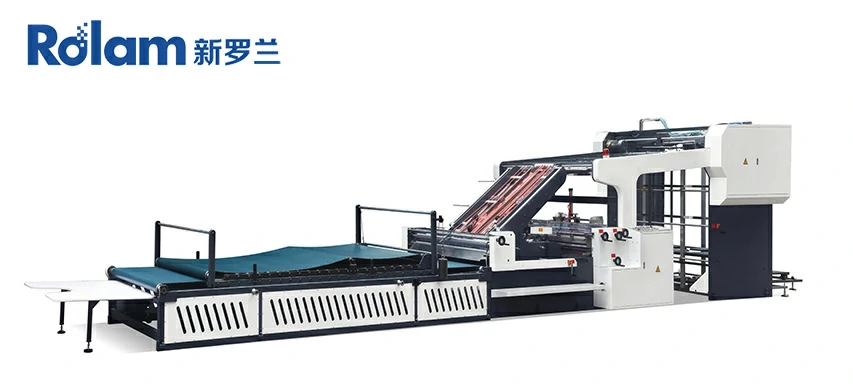
The Intelligent Laminating Machine YB-1450G/1650G from Gaoke Machine is built around the glue-consistency chain the page describes: a ground stainless steel glue roller, an intelligent glue supply recovery system, a cleaning water cycle, an anti-rejection protective device, and a bottom belt cleaning roller, all running at 150 m/min with ±1mm fitting precision across a 150–600g top sheet and 300g–4mm bottom sheet envelope. The three-correction feeding system and the intermittent front gauge keep the sheets positioned so the glue film lands on the bonding area rather than the trim edge. For a Flute Laminating Machine buyer running cardboard-to-flute or cardboard-to-cardboard work, the value sits in the glue circuit: the film that reaches the roller at the start of a shift is the same film that reaches it at the end, so the bond strength doesn't drift with the reservoir level or the roller surface condition.
What to confirm before matching a board to the YB-1450G/1650G
Confirm the maximum sheet against 1450×1300mm (YB-1450G) or 1650×1450mm (YB-1650G), the top sheet weight against 150–600g, and the bottom sheet thickness against 300g–4mm. The ±1mm fitting precision and 150 m/min speed are machine-level figures—the actual result on a given board depends on the board's flatness, the adhesive's open time, and the tracking system's ability to read the sheet edges. A trial on the actual board combination confirms whether the glue film and the positioning hold together at the target speed.
Let's Match a Board Combination to the YB-1450G/1650G
Send over your maximum sheet size, top sheet weight, bottom sheet thickness, and adhesive type—we'll help you check them against the 1450×1300mm / 1650×1450mm sheet envelope, the 150–600g / 300g–4mm material ranges, and the glue circuit configuration. Talk to Gaoke Machine about your Flute Laminating Machine requirements and get a format-level answer before you commit to the line.