 English
 Español
 Français
 Português
How Does a Folding Gluing Machine Turn One Flat Blank Into a Glued Six-Corner Box?
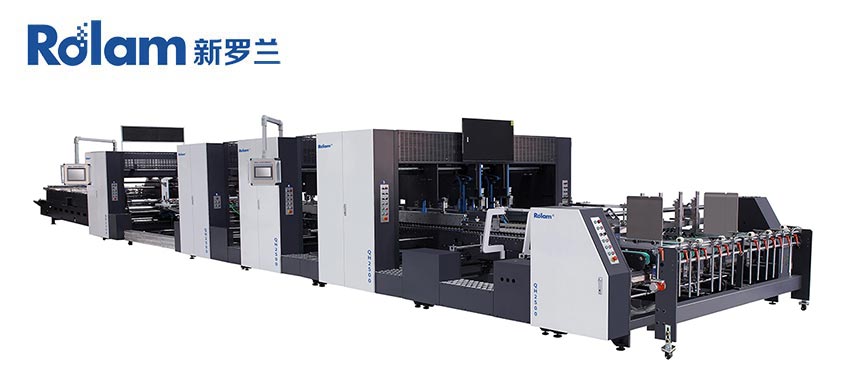
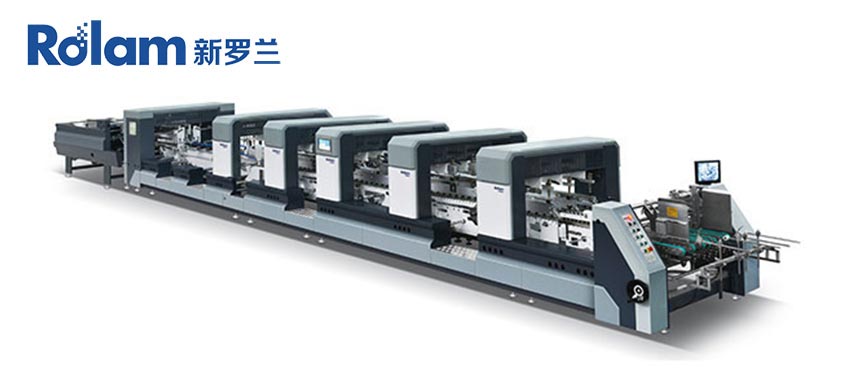
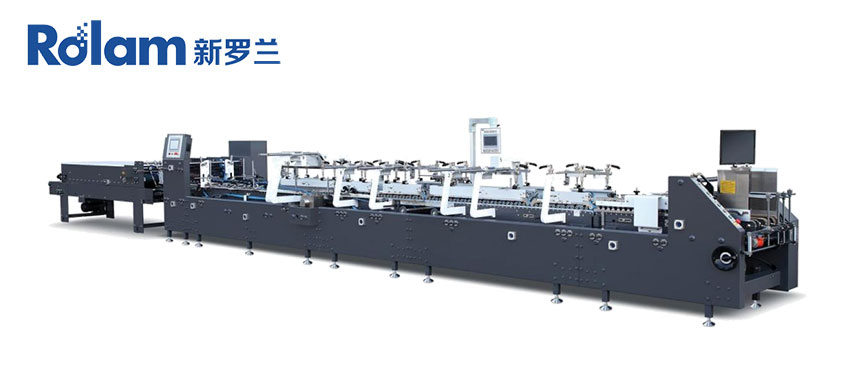
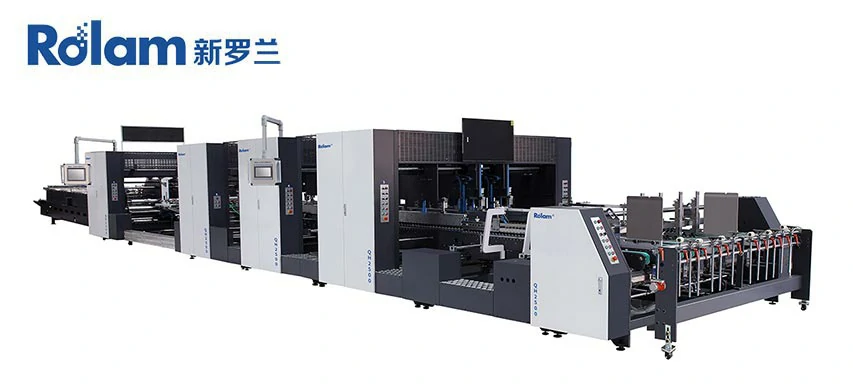
A six-corner box starts as a flat blank with corner panels at each end, and it leaves the line as a tray. A Folding Gluing Machine in the QH class does that to 3-ply and 5-ply board at up to 280m/min, on a frame 24m long. Here's what happens between those two states.
What the Blank Has to Look Like First
Which Shapes Can It Make?
Four: straight-line cartons, crash-lock bottom cartons, four-corner boxes, and six-corner boxes. The corner families are the ones worth pausing on — those end panels are what turn a flat blank into a tray instead of a sleeve, and they're folded back by a motorized, untimed electronic system running on servo technology.
How Wide and How Thick?
Three widths: blank 1700, 2100, 2500mm. The folded box measures 12mm at most, which is the figure that sets the board ceiling — 210-800gsm cardboard and A/B/E flute corrugated. Past that thickness a tray stops behaving like a tray and starts behaving like a crate.
How Fast Does It Run?
280m/min maximum, on 60kW total power, whichever width you take. That the power figure doesn't move across the three builds is the detail worth noticing: the drives are sized for the line rather than for the web, so a narrower machine doesn't buy a smaller supply.
The Crease That Gets Made Twice
Why a Fish Tail Is a Folding Problem
A separate secondary-creasing unit sits ahead of the fold, and its job is narrow but decisive: it re-cuts the indentation line the corrugated board already carries. Fish tails come from a handful of causes — improper die-cutting, a crease set too shallow, board that pushed back — and they all end the same way, with a corner that folds off line. Creasing a second time corrects that line before the fold commits to it, and it's also what makes 3-ply and 5-ply board workable here instead of marginal.
Servo at Every Section
What Linear Guides Change
Every section runs on its own servo motor and adjusts on linear guides, instead of sharing one main drive and sliding into place. The practical difference is repeatability: a section positioned by a guide comes back to the same setting after a changeover, while one pushed along a slide comes back to roughly the same setting. That gap shows up as scrap on the first fifty boxes of every run.
Two Places That Don't Share a Speed
The folding section carries its own servos so its belt speed can be set apart from the rest of the line, and the trombone section has an independent motor for belt size. Both are places where one common speed would be a compromise, and both are solved by not sharing one.
Handing the Blank Over Square
The Vibration Device's Job
Feeding is continuous and automatic, with air suction at the pile, a multi-stage rail keeping the pressing board vertical, and left and right baffles that adjust up and down to shorten carton changes. The vibration device works with the motor to keep blanks arriving one after another rather than in clumps — a small detail that decides whether a shift runs continuously or stutters. A skewed lead edge never gets corrected downstream; it just gets glued skewed.
Three Widths, One Power Figure
Everything Moves Except the Width
Same 280m/min, same 12mm folded ceiling, same servo-per-section layout, same 3P380V50Hz supply, same 60kW. What changes is the blank — 1700, 2100, 2500mm — with net weight stepping 14.5, 15.5, 18T and the frame widening from 2.9 to 3.7m at a constant 24m length.
| Item | QH 1700 | QH 2100 | QH 2500 |
|---|---|---|---|
| Paper material | Cardboard 210-800gsm; A/B/E flute | Cardboard 210-800gsm; A/B/E flute | Cardboard 210-800gsm; A/B/E flute |
| Max speed | 280 m/min | 280 m/min | 280 m/min |
| Max thickness of folded box | 12 mm | 12 mm | 12 mm |
| Way of folding | Fold 1 and 3 at 180°/135°; fold 2 and 4 at 180° | Fold 1 and 3 at 180°/135°; fold 2 and 4 at 180° | Fold 1 and 3 at 180°/135°; fold 2 and 4 at 180° |
| Power supply | 3P380V50Hz | 3P380V50Hz | 3P380V50Hz |
| Blank width | 1700 mm | 2100 mm | 2500 mm |
| L×W×H | 24×2.9×2.05 m | 24×3.3×2.05 m | 24×3.7×2.05 m |
| Net weight | 14.5 T | 15.5 T | 18 T |
| Total power | 60 kW | 60 kW | 60 kW |
A Blank Measured Across
The sample tables quote a blank as a sum rather than a single figure: A+B+C+D+E 520-1700mm on a straight-line box, 500-1600mm on a crash-lock or six-corner layout, and 340-1600mm on a four-corner. Flap E spans 30-500mm, F 300-1400mm, G tops out at 1600mm, lock height H is 45mm minimum, and L runs 40-150mm. Width scales with the model; F, G, H, and L don't — so the real ceiling on this family is the blank's cross direction, not its length.
When the Machine Stops Itself
The Screen at the Side
A side touch screen carries speed, output, and fault alarms, and from it the operator starts and stops the line, works the paper feeding clutch, runs the box-receiving end, and enters parameters. PLC control with a photocell screen means adjustment happens at a panel instead of at six handwheels.
Why It Stops Without Being Told
The press and transmission unit holds a waiting function: when feeding pauses, it drops into standby, and if collection goes wrong it stops the machine. Between that, automatic fault diagnosis, and a wireless remote, the pattern is consistent — this is a machine built to halt itself before it builds a pallet of scrap.
Rolam, the 24 Meters, and the Enquiry
What the Floor Has to Give
Rolam Intelligent Technology builds the QH Series Heavy Duty Folder Gluer on a stainless steel frame, at 24m long and up to 3.7m wide before the aisle is counted. The foundation drawing carries an 8mm three-way air connector and a separate electric box, so services are part of the layout rather than an afterthought. Electrical and drive components are specified as imported items meeting European and American safety standards.
What to Send With the Enquiry
Send the box shape and the blank, and the width question answers itself:
- Which family: straight-line, crash-lock, four-corner, or six-corner.
- The A+B+C+D+E total, plus F, G, and the flap.
- Board grade and ply count.
- The output you need to average per shift.
A Folding Gluing Machine is sized from a blank, so a die drawing beats a paragraph of description.
Send the Blank and the Box Shape
What to Put in the Message
Put the box shape, the blank total, and the board grade in the first message. Those three narrow the model to one, and they're already sitting on your die drawing.
Send them through our request a quotation form and we'll come back with a Folding Gluing Machine sized to your blank, your board, and the shape your customers actually order.