 English
 Español
 Français
 Português
How Does a Film Laminator Prevent Raw Edges?
You're standing at the delivery end of a lamination line, checking the edge of a finished sheet. A Film Laminator prevents film raw edges by using a hot-knife cutting station that melts through the film rather than shearing it, sealing the cut edge as it separates the sheets. This article explains how the hot-knife mechanism works, what the feeder and glue system contribute to the finished sheet, and what to verify when you're specifying a high-speed lamination line for commercial printing or packaging.
Why Does Hot-Knife Cutting Change Edge Quality?
Melting vs. Shearing the Film
Conventional film cutting uses a mechanical blade that shears through the laminated sheet. The shear cuts the film and the paper together, but it leaves a narrow band of exposed film at the edge where the cut passes through the adhesive layer. That raw edge can peel, curl, or collect dust over time.
The hot-knife method uses a heated blade that melts through the film layer as it descends. The melted film seals itself against the paper edge, closing the cut and leaving a finished edge that resists peeling. The KFM-106MC uses this hot-knife cutting approach, with a scissors-type cutting mechanism that adopts unidirectional lifting paper-drawing roller technology. That combination suits high-speed lamination across various sheet sizes, with stable cutting action and no film raw edge.
What the Scissors Mechanism Adds
The scissors-type cutting mechanism separates the cutting action from the paper transport. The unidirectional lifting roller draws the sheet forward while the hot knife descends, so the cut happens on a moving web without the sheet stalling or shifting. The result is a cut that follows the sheet edge precisely, regardless of whether the sheet is large or small.
How Does the Feeder Maintain ±2mm Accuracy?
The feeder is where lamination quality begins. A sheet that arrives at the laminating nip slightly off-register will produce a finished product with uneven margins. The KFM-106MC uses a servo-controlled feeder with overlap control held within ±2mm. The four-suction, four-delivery feeder head holds paper straightness to ±2mm, and the shaftless servo drive gives the head a long service life.
The feeder head can move forward and backward automatically, which simplifies the changeover between large and small sheet sizes. The overlap joint is servo-controlled to keep the feed rhythm consistent, and the bridge crossing uses a full conveyor belt to prevent paper jams. Air suction and pressing wheels work together to hold the sheet flat during high-speed feeding, so the paper doesn't displace before it reaches the lamination nip.
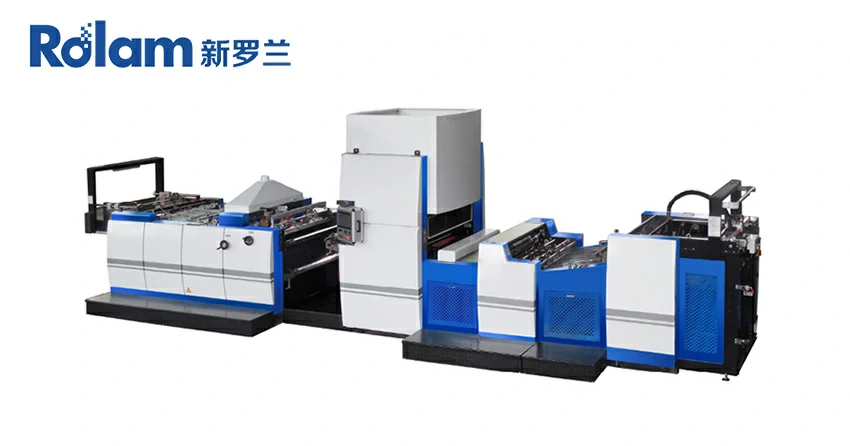
| Parameter | KFM-106MC Specification |
|---|---|
| Max. sheet size | W1060×L1200mm |
| Min. sheet size | W320×L290mm |
| Sheet thickness | 105–500 g/m² |
| Mechanical speed | 100 m/min, or 9,000 sheets/hour |
| Feeder pile height | 1300 mm |
| Installed power | 70kW |
| Actual production power | 28–35kW/h |
| Overall dimensions | 11200×2100×2900mm |
What Does the Glue Coating System Control?
Roller Precision and Coating Tolerance
The glue coating roller is a steel roller fitted with imported high-precision bearings. The roll surface stays uniform under high-speed operation, and the wear-resistant surface holds its geometry over long production runs. The coating accuracy is controlled within ±0.0025mm, and the system runs without a glue rod or lateral movement.
That tolerance matters because a glue layer that varies across the sheet produces lamination with uneven adhesion. Thin spots can delaminate after cutting; thick spots can squeeze out at the edges and foul the hot knife. The steel roller and precision bearings keep the laydown consistent from the first sheet to the last.
How the Drying Roller Cures the Adhesive
The large-diameter drying roller uses advanced heating lamps to hold a constant temperature across the roll surface. Hot air combines with the heated roller to cure the water-based adhesive quickly, which is what allows the line to run at high speed without the film shifting after lamination. The roller surface uses a non-adhesive high-temperature-resistant material that resists glue buildup and simplifies cleaning.
How Does the Thermal System Keep Rollers Constant?
The mirror heating roller is 380mm in diameter, and its temperature is held constant by a mold temperature machine with a heat-transfer-oil internal circulation system. The oil circulates inside the roller, so the surface temperature stays even across the full width and through the full production run. That even temperature is what keeps the lamination hot-pressing time consistent, which in turn produces a bond that doesn't vary from sheet to sheet.
The advantage of the oil circulation system is visible at high speed: a roller heated by a single element at one end runs hotter near the element and cooler at the far end, which shows up as lamination variation across the sheet width. The circulating oil distributes heat across the entire roller body, so the surface temperature difference stays small even when the line is running at its top speed.
Where Does Powder Removal Fit in the Process?
Printed sheets carry spray powder from the offset press. That powder sits on the ink surface and, if it isn't removed before lamination, becomes trapped under the film. The trapped particles show up as visible bumps or hazy spots that spoil the finished appearance.
The KFM-106MC offers an electric powder removal mechanism with automatic constant-temperature heating. The mechanism is optional, but for work coming off a high-pile offset press, it's the step that separates a clean lamination from a speckled one. The constant-temperature heating keeps the powder removal function stable across the production run, so the cleaning effect doesn't fade as the machine warms up.
What Happens at the Stacker After Cutting?
The stacker is where the finished sheets are collected, and its job is to keep them flat, aligned, and free of damage. The KFM-106MC uses a pneumatic paper beater with two-way action, single-sheet or multi-sheet, and a conveyor belt with a wave-pressing function that increases paper stiffness in thin-paper production. The paper-receiving table has a deceleration function to prevent thick paper from damaging the paper edge as it lands.
The stacker also includes a double-sheet rejection mechanism. When two sheets arrive together, a photoelectric signal triggers the receiving belt to accelerate instantly and blow the double sheets away from the table. That rejection function keeps the finished pile free of double laminations, which would otherwise cause downstream feeding problems in folding or die-cutting.
Straight Answers on Hot-Knife Lamination
What's the difference between hot-knife cutting and fly-cutter cutting?
A fly-cutter uses a rotating blade to shear the sheet as it passes. A hot knife uses a heated blade that melts through the film and seals the edge. The hot-knife method eliminates the raw edge that a shear cut leaves, which means the finished sheet has a cleaner, more durable edge. The KFM-106MC uses the hot-knife approach with a scissors-type mechanism for stable cutting across sheet sizes.
Can the machine run thin paper without curling?
The KFM-106MC includes a thin-paper unfolding mechanism to prevent thin paper from rolling up after lamination. The stacker's wave-pressing conveyor belt also increases paper stiffness during thin-paper production, which helps the sheet stay flat as it transfers to the receiving table.
What sheet sizes does the feeder handle?
The maximum sheet size is W1060×L1200mm and the minimum is W320×L290mm. The feeder head can move forward and backward to accommodate the range, and the servo overlap control keeps the feed accurate across that spread.
What power consumption should I plan for?
The installed power is 70kW, but the actual production power consumption runs 28–35kW/h depending on the load. That distinction matters for facility planning: the electrical service has to handle the installed load, but the operating cost tracks the actual consumption figure.
Let's Match a Lamination Line to Your Production
Share Your Sheet Size and Film Requirements
A Film Laminator with hot-knife cutting should match your sheet dimensions, paper weight, and edge-quality requirements—not the other way around. The Automatic Hot Knife Film Laminating Machine KFM-106MC from Gaoke Machinery runs at 100m/min or 9,000 sheets/hour, handles sheets from W320×L290mm to W1060×L1200mm on 105–500g/m² stock, and uses a ±0.0025mm glue coating tolerance with a 380mm mirror heating roller held constant by oil circulation. The hot-knife scissors cutting mechanism delivers a sealed edge without raw film, and the stacker includes double-sheet rejection. If you're specifying a lamination line for commercial print, packaging, or finishing, send us your sheet size and film requirements — we'll help you confirm the right configuration before you order.